1.Introduction
“Accident” is an event caused by an external factor, which at the same time does not depend on humans, has fast action and the damage it can cause is either physical or mental.[1] Due to their nature, children are particularly prone to accidents, as they are characterized by immaturity, increased curiosity, ignorance of danger and carelessness. Indeed, according to data, in Greece every year 500,000 children are injured by various causes, of which 700 lose their lives and 3,000 acquire disabilities.[1, 2]
If one considers that children spend a third of their day at school, school accidents aren’t unusual and falls represent a leading cause of school injuries.[3] Although there are no public reports to provide annual national breakdowns of injuries specifically in schools for 2020–2025, previous studies reveal that both in Austria and in the United States of America, 10%-25% of all childhood injuries occur during school hours.[4, 5, 6] The courtyard is the place where school accidents mostly occur, followed by classrooms and staircases.[7] Most of these accidents occur during breaks and the causes are the large number of children in a specific area, their lack of supervision due to the small number of educational staff and the unsuitability of the floors.[8]
Studies have shown that sprain, shortness of breath, seizure, extremity fracture, head/neck injury, laceration, psychiatric emergency, abdominal pain, syncope, anaphylaxis, chest pain/palpitation or bleeding, fainting, fractures, dislocations, and minor injuries were the most frequent injuries.[9, 10] Another study of children requiring First Aid in school revealed that epistaxis (90.5%), high fever (77.9%), and head trauma (55.8%) were the top three causes.[11]
More so, one of the main causes of injury-related morbidity and death is choking.[12] Toys, coins, and food are the main causes of choking-related incidents involving children that result in injury or death. For children older than one year, choking can be treated with a mix of abdominal push and back blows using basic First Aid techniques. The Heimlich maneuver is a highly successful procedure for clearing a foreign object-obsessed airway.[13]
Taking into consideration that when procedures are carried out quickly and efficiently, potential risks to the victim’s health are minimized,[14, 15] it is necessary to ensure that an adequate number of staff possess emergency management knowledge.
It is primarily the responsibility of the existing health personnel to make the initial interventions necessary in the case of accidents involving schools or problems that may arise for students as a result of emergencies or existing illnesses. Within school health services, the school health nurse has important duties. It is necessary for the nurse to coordinate with school administrators on issues related to school health services, to identify needs, to identify health risks early, and to plan appropriate initiatives and take the necessary measures.
However, as there are still very few schools with trained health care professionals (doctors or nurses) in their premises as permanent employees, this duty falls instead on the teachers. Teachers, as full-time employees are the main care givers and can be the first line protector of children at school. This is also the case for Greece where only 18.9% of school units in Greece are covered by a school nurse,[16] who is responsible for all students in the school unit and is the only health professional in the school.[17] Thus, in practice, teachers are the ones who undertake the management and treatment of emergencies that arise in school units.
However, research reveals poor or incorrect practices associated with injuries, illnesses and first aid management among schoolteachers.[18] The necessary training - education of professionals is scarce as in very few universities the course of First Aid is taught, and teachers’ knowledge of First Aid usually occurs from training and is mainly based on their own initiative.
Therefore, the aim of this study was to evaluate the knowledge of First Aid of primary school teachers working in public and private schools.
2.Method
2.1 Participants and setting
The study was conducted on a sample of 407 primary education teachers. Online cross-sectional research lasted 35months, the data collection was performed using the Google Forms platform. To participate in the study, teachers were required to meet the following inclusion criteria: 1) practice in primary education as kindergarten teachers, teachers of general education, special education, foreign languages, physical education, visual arts, informatics, music, theater education, 2) able to fill in the questionnaire and 3) ensuring their consent to be included in the research.
2.2 Measurements
Data were collected using a questionnaire developed following a thorough review of the existing literature and drawing upon the methodologies of previous related studies.[19, 20, 21]
The questionnaire comprised a total of 59 multiple-choice items, categorized into three sections: 8 items pertaining to demographic characteristics, 21 items assessing general knowledge and perceptions regarding First Aid and 30 items evaluating specific First Aid knowledge. The instrument was designed to be both comprehensive and time-efficient, requiring no more than fifteen minutes to complete.
The questionnaire remains one of the most widely adopted methods for data collection. It is especially convenient for reaching individuals dispersed across large geographical areas or residing in remote locations. In particular, the online questionnaire allows for easy distribution and broad accessibility, especially among younger demographic groups. Additionally, participants benefit from the flexibility to respond at their own convenience, both in terms of time and setting.[22]
Moreover, a carefully selected sample enhances the validity of the research. The sample used in the present study reflects a diversity of demographic characteristics—including age, gender, educational level, work experience, employment sector, smoking habits, and computer literacy—and is not confined to a specific geographic region of Greece. This approach allows for a comprehensive and holistic assessment of primary education teachers’ knowledge of First Aid.
2.3 Data analysis
Descriptive statistics (frequency distribution, percentages, mean, median, standard deviation) were used for data analysis. The R Project for Statistical Computing was used for statistical analysis, while the main study frequency tables were statistically tested using Chi- Square and Fisher’s Exact Test depending on the expected frequencies.
2.4 Ethical consideration
Teachers were informed of the purpose of the study and the procedures used to ensure anonymity. Participants in the study had the right to withdraw from the research without any consequence, while they had the opportunity to carefully consider their decision. Those who agreed to take part in the study gave their consent by filling in their e-mail address.
3.Results
3.1 Teachers’ sample characteristics
The sociodemographic characteristics of teachers practicing in primary education are shown in Table 1. The average age of the participants was 41.5 years. Men made up 26.8% of the sample, while women made up 73.2% with an average of 121.1 (range: 10-396) months of service. In terms of marital status, married people with children constituted the majority of the sample (45.9%), followed by single people without children (38.1%). A 9.8% was made up of married people without children. Regarding their educational level, the high percentage of 99.3% corresponded to the answers given by people with a university degree, while 0.7% of the sample were graduates of technological educational institutions. 227 of the 407 respondents to the survey, i.e. 55.8%, had a postgraduate degree. 94.9% of them held a master’s degree, while a much smaller proportion (5.7%) also held a doctorate. The teachers surveyed worked in the public and private sectors. More specifically, 88% of them worked in the public sector, while 49% of the teachers were employed in private primary schools. There was also a relative uniformity of the sample, covering a wide range of ages.
| Sex | Females | 298 (73.2) |
| Males | 109 (26.8) | |
| Age (years) | Mean ± S.D. | 41.5± 18.2 |
| Marital status | Single | 155 (38.1) |
| Single with children | 5 (1.2) | |
| Married | 40 (9.8) | |
| Married with children | 187 (45.9) | |
| Widowed | 1 (0.2) | |
| Widowed with children | 2 (0.4) | |
| Engaged | 1 (0.2) | |
| Divorced | 6 (1.47) | |
| Divorced with children | 10 (2.46) | |
| Educational level | Secondary school | 0 (0) |
| Technological institute | 3 (0.7) | |
| University | 404 (99.3) | |
| Employment sector | Public Sector | 358 (88) |
| Private Sector | 49 (12) | |
| Experience (months) | Mean ± S.D. | 121.1 ± 120.7474 |
Tables 2 and 3 present the demographic characteristics of the study participants according to their work sector.
| Sex | Females | 262 (73.2) |
| Males | 96 (26.8) | |
| Age (years) | Mean ± S.D. | 42.68 ± 18.76 |
| Marital status | Single | 122 (34.1) |
| Single with children | 4 (1.1) | |
| Married | 35 (9.8) | |
| Married with children | 178 (49.7) | |
| Widowed | 1 (0.3) | |
| Widowed with children | 2 (0.6) | |
| Engaged | 1 (0.3) | |
| Divorced | 5 (1.4) | |
| Divorced with children | 10 (2.8) | |
| Educational level | Secondary school | 0 (0.0) |
| Technological institute | 1 (0.3) | |
| University | 357 (99.7) | |
| Experience (months) | Mean ± S.D. | 131.02 ± 123.07 |
| Sex | Females | 36 (73.5) |
| Males | 13 (26.5) | |
| Age (years) | Mean ± S.D. | 32.57 ± 8.68 |
| Marital status | Single | 33 (67.3) |
| Single with children | 1 (2.0) | |
| Married | 5 (10.2) | |
| Married with children | 9 (18.4) | |
| Divorced | 1 (2.0) | |
| Educational level | Secondary school | 0 (0) |
| Technological institute | 2 (4.1) | |
| University | 49 (95.9) | |
| Experience (months) | Mean ± S.D. | 49.33 ± 66.60 |
Participants in the study working in the public sector were distributed as follows: 73.2% women and 26.8% men. Their average age was 42.68 years and about half (49.7%) were married with children. Almost all those working in the public sector hold a university degree with an average of 131.02 months of service.
On the other hand, there is similar proportion of women and men employed in the private sector. Women constituted 73.5% of the sample working in the private sector, while men constituted 26.5% with an average age of 32.57 years. The majority of private sector workers were single (67.3%) and held a university degree (95.9%). The average number of months of service was 49.33 months.
3.2 First Aid knowledge adequacy
Data revealed that less than 50% of primary education teachers have knowledge of basic life support (BLS) that is Cardiopulmonary Resuscitation (CPR) (see Figure 1).
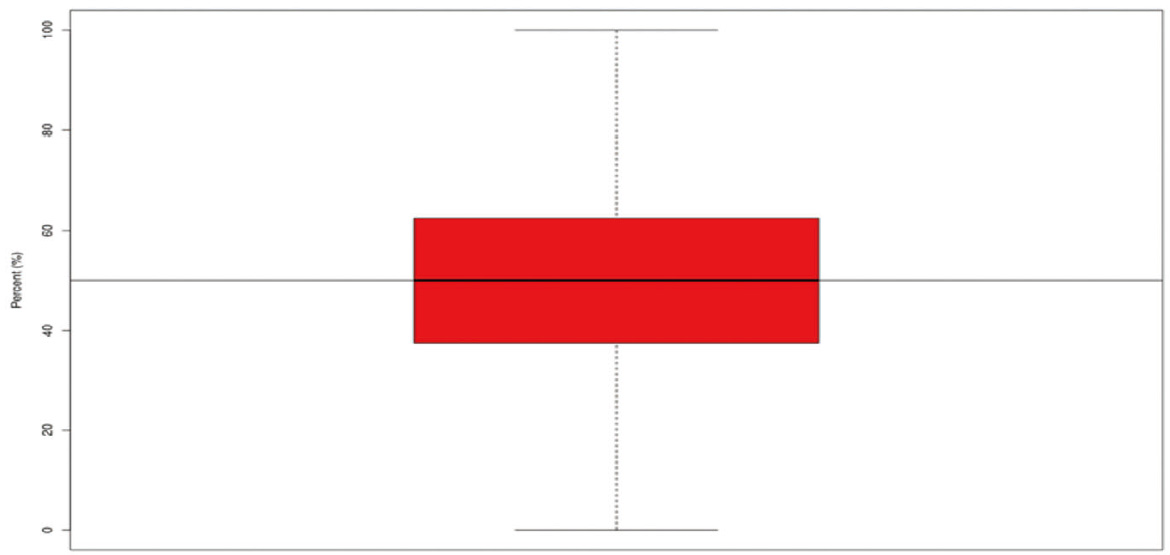
Figure 1.
Percentage of CPR correct answers
Figure 1 shows the distribution of correct answers in the CPR questions. A participant is considered successful if he/she answered at least half the questions right. It is evident from the box plot that approximately half of the participants (median thick black line on box) did not achieve the score indicating sufficient knowledge of CPR.
Data stressed out a significant differentiation between teachers who received training in CPR and those who did not, with those trained seeming to perform better in the questions concerning their knowledge of CPR (see Figure 2).
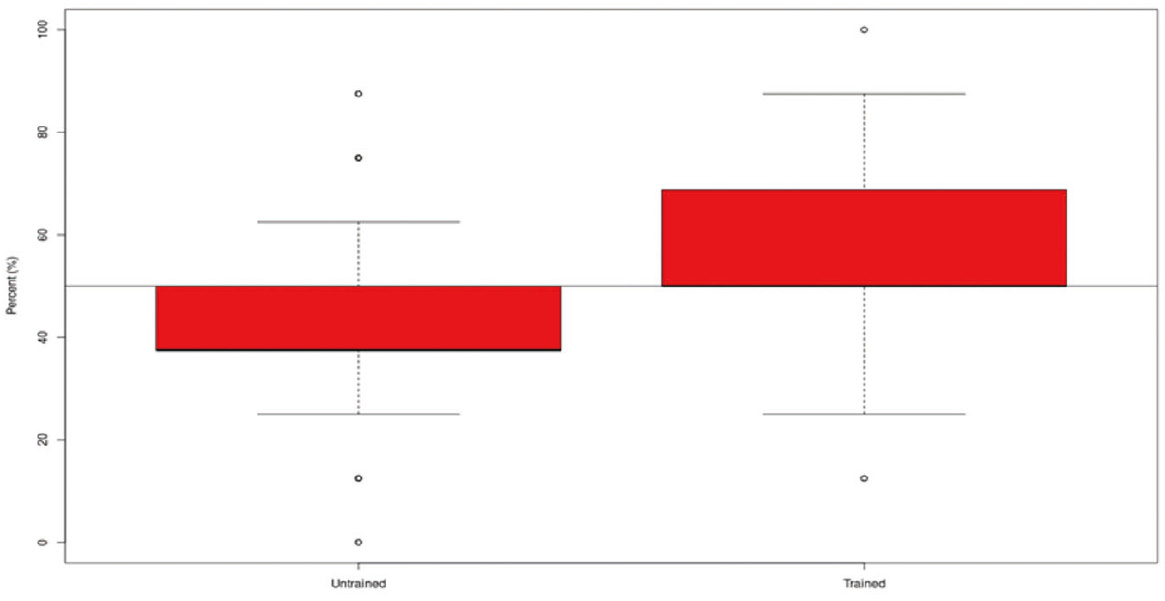
Figure 2.
Percentage of CPR correct answers by training
Figure 2 shows the distributions of the correct answers of trained and untrained participants in CPR. Notice that most untrained participants do not achieve the successful score (50% of correct answers), while many trained participants achieve and surpass the successful score. This difference is statistically significant.
Concerning automatic external defibrillator (AED) knowledge adequacy of the use of defibrillator, only 6% of untrained recipients have answered correctly to the question, while a much larger proportion of trained teachers (24%) answered correctly to the same question (see Table 4).
| Total | 313 | 94 | .00003068 |
| Correct | 19 | 23 | |
| Percentage of Participants Answering Correctly | 6 | 24 |
The factor of knowledge of defibrillator handling (Automated External Defibrillator - AED) in relation to the correct answers given in the questionnaire shows statistically significant results. More specifically, 94 of the 407 study participants reported that they had received some form of training on defibrillator handling. 23 of them answered correctly to the multiple-choice question on what follows defibrillation. Therefore, the success rate for this question was 24% compared to the success rate of those who had not received training which was 6%. This difference is statistically significant.
Finally, less than half of all respondents answered correctly at least half of the questions, revealing insufficient overall knowledge of First Aid (see Figure 3).
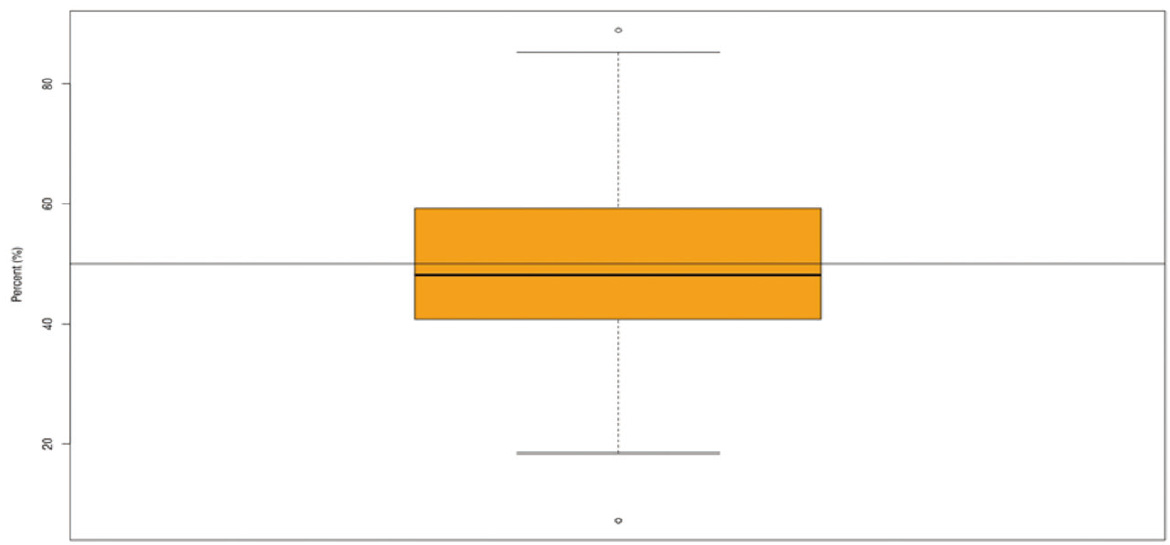
Figure 3.
Distribution of percentage of total correct answers
Figure 3 shows the distribution of correct answers across all the questions regarding First Aid. Notice that from the median below the 50% score line, a marginal majority of the participants did not reach the 50% successful score mark.
3.3 Differences in knowledge of First Aid in public and private schools
Concerning First Aid knowledge adequacy of the use of defibrillators, data did not reveal significant differences between primary education teachers in public and private sector (see Table 5).
| Total | 358 | 49 | .45 |
| Correct | 39 | 3 | |
| Percentage of Correct | 11 | 6 |
Only 39 out of 358 of the participants working in the public sector answered the defibrillator questions correctly, i.e. 11%. On the contrary, the percentage of correct answers from those working in the private sector was 6%.
Data provides evidence that the overall performance of public and private sector teachers in primary education does not differ. Even though a difference in favor of the public sector is observed, it is not statistically significant (see Figure 4).
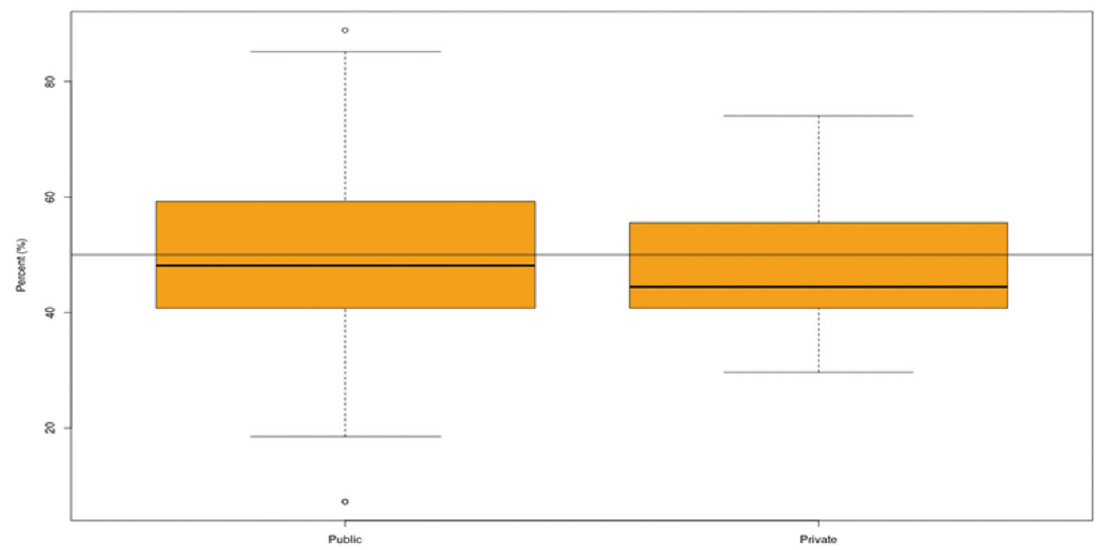
Figure 4.
Percentage of total correct answers Public vs Private Sector
Figure 4 shows the performance of participants divided into public and private sector. The two box plots show comparable performance, with the public sector performing slightly better. This result however is not statistically significant, suggesting similar performance for both sectors.
Regarding the questions about the participants’ knowledge of First Aid, there is a statistically significant difference in the data when we categorize our sample into participants who have received First Aid training and those who have not. More specifically, 58.9% of those who had been trained in First Aid answered at least half of the questions correctly. Contrariwise, those who reported that they had not been trained in First Aid had a lower success rate, with only 25.8% of them managing to answer at least half of the questions correctly (see Table 6). More so, Figure 5 reveals that there is statistically significance of the training factor.
| Total | 275 | 132 | .0001523 |
| Correct | 162 | 34 | |
| Percentage of Correct (%) | 58.9 | 25.8 |
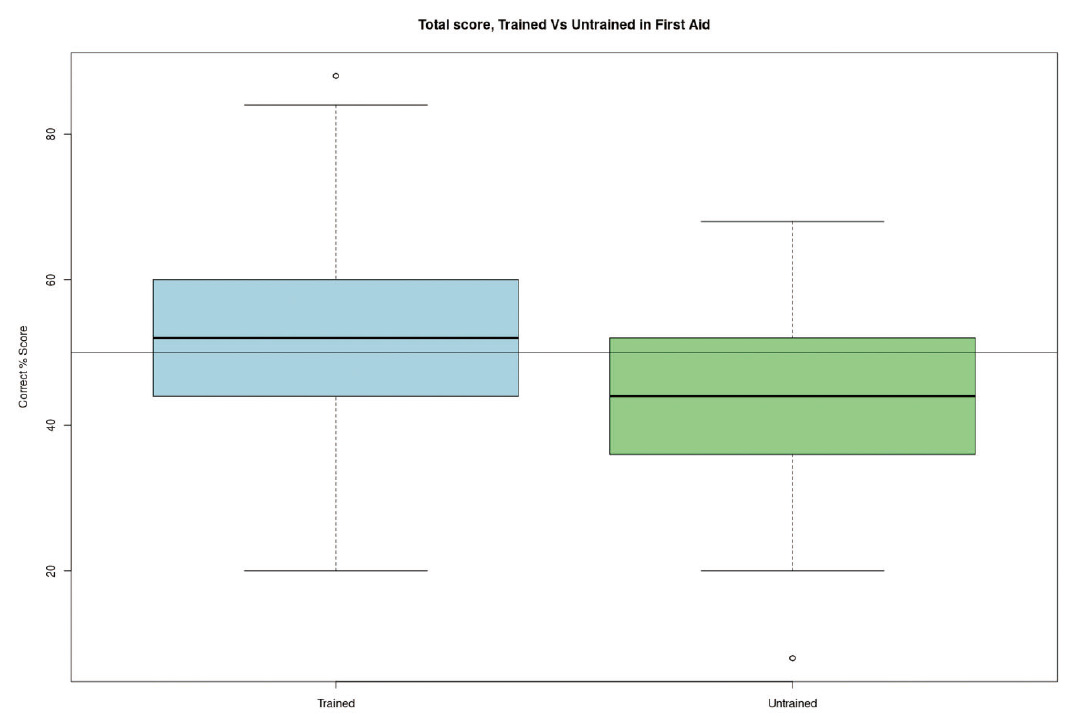
Figure 5.
Percentage of total correct answers Trained vs Untrained in First Aid
Figure 5 shows the performance of participants divided into Trained and Untrained in First Aid Administration. The two box plots show higher performance for Trained personnel, as they tend to achieve higher scores overall and more than half the Trained participants achieved and surpassed the 50% successful score. On the contrary, Untrained participants seem to perform worse in the questionnaire and, as the median line shows, fewer than half the Untrained participants reach the successful 50% result. This result is statistically significant.
Regression for training as a binary predictor for first aid knowledge
Linear regression was performed on the Total Percentage of Correct Answers using the Training on First Aid question as a binary independent variable (Yes = 1, No = 0) to judge its effect on correct answers (see Table 7). The model yielded interesting results, being statistically significant, F (1,405) = 53.64,
| Intercept | 43.545 | 1.031 | 42.256 | < .001 |
41.520 | 45.570 |
| Training (1 = Yes, 0 = No) | 9.182 | 1.254 | 7.324 | < .001 |
6.716 | 11.648 |
| Values | 11.84 | 0.117 | 0.1148 | 53.64 | < .001 |
The intercept, representing the mean test score for individuals without training, was 43.55% (b = 43.545 , SE = 1.031,
In other words, data reveal that First Aid training affects the success rate on the questions of the questionnaire. Characteristically, those who have been trained on First Aid performed better on the test by 9.2% (9.182%). Looking at the data, 58.9% of those who have been trained answer at least half of the questionnaire questions correctly, while only 25.8% of those who have not been trained on First Aid answer correctly. Therefore, a higher success rate is achieved to a greater extent by those who have been trained. The model demonstrates that those who are trained are expected to answer correctly by 9.2% more than those without training.
Participants who have not received such training answer at least half of the questions correctly by 43.5%, a below-baseline rate that confirms the lack of knowledge on First Aid. On the other hand, participants who have been trained answer at least half of the questions correctly by 52.7%, a percentage above the baseline that confirms knowledge competence. Therefore, the difference in performance between the two groups under study is 9.2%.
The above findings are stressed out in figure below which shows that participants who received First Aid training exhibited a higher median test score compared to those without training (see Figure 6).
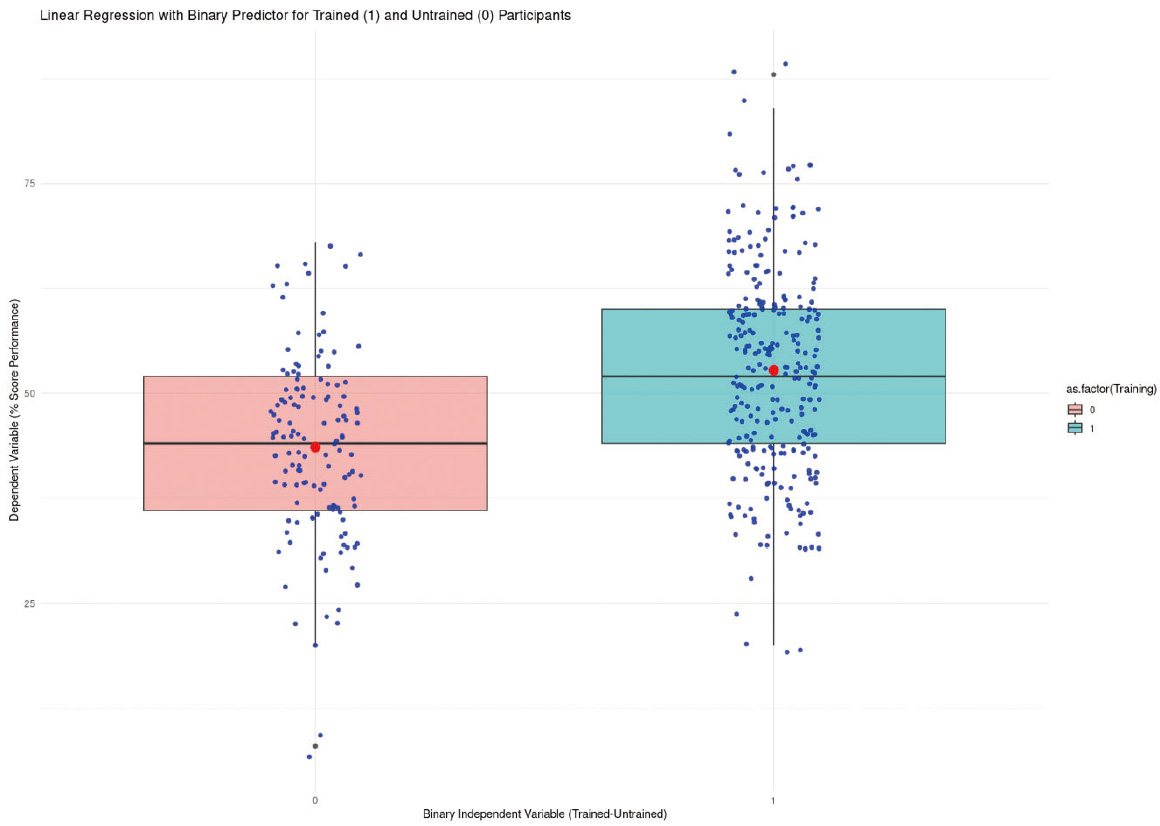
Figure 6.
Linear regression model plot on dependent variable total correct answers % (0-100) and independent variable training in First Aid (0,1)
Figure 6 presents a boxplot illustrating the distribution of test scores (%) among participants with and without First Aid training. The central boxes represent the interquartile range (IQR), with the median score marked by the horizontal line within each box. The whiskers extend to 1.5 times the IQR, with individual points beyond these limits representing potential outliers. Participants who received First Aid training (coded as 1) exhibited a higher median test score compared to those without training (coded as 0). The presence of a red dot within each category indicates the mean score, reinforcing the observed trend of higher performance among trained participants. Overlaid jittered points (blue) display individual test scores, demonstrating variability within each group. The visualization supports the regression analysis, suggesting that First Aid training is associated with a statistically significant increase in test performance. The median of the data of those who have received First Aid training is higher, as is the mean score.
4.Discussion
This study is the first of its kind in Greece to explore and document the knowledge, skills, and educational gaps of primary school teachers regarding First Aid. Data were collected from educators working in both public and private schools, with the ultimate goal of proposing recommendations for more effective and comprehensive First Aid training.
Thousands of childhood accidents occur annually, the majority of which take place within the school environment.[5, 6, 23, 24] These incidents are closely linked to the characteristics of childhood—such as immaturity, playfulness, vulnerability to unintentional injuries, and lack of fear.[7, 25] Therefore, the need for proper training and continuous education of teachers in First Aid becomes even more imperative.
The importance of teacher training in First Aid becomes even more pronounced considering that the majority of public schools in Greece lack professional school nurses.[16] In such settings, teachers are often the first and only responders during medical emergencies, which further underscores the critical nature of their preparedness. Even in cases where a school nurse is present—especially in densely populated urban schools—it would be impossible for a single individual to handle multiple incidents simultaneously. Therefore, the involvement of teachers in emergency response, whether or not a school nurse is present, remains indispensable.
The sample consisted of 407 educators working in both the public and private sectors, with a gender distribution of 73.2% female and 26.8% male. Although research on the male-to-female ratio in education, particularly primary education, is limited, it is worth noting that in 2005, male primary education teachers accounted for 20% in industrialized European countries, while the corresponding percentage in the USA was 24.4%.[26]
The findings of this study highlight the low level of knowledge among educators regarding general and specific First Aid topics, including Basic Life Support (BLS), CPR, and the use of an Automated External Defibrillator (AED). Similar levels of knowledge concerning First Aid have been reported in other international studies.[27, 28, 29]
Given that only 3 out of the 18 education faculties in Greece offer First Aid as an elective course, there is a significant gap in the preparation of teachers entering the profession. This knowledge gap should be addressed through educational interventions, especially since participants themselves recognize that both their knowledge and confidence in First Aid are low. In many Western countries (e.g., the USA), First Aid training for teachers is mandatory and a prerequisite for obtaining a teaching license.[30]
A similar situation is observed both internationally and in Greece, as previous research has shown that a large proportion of teachers are inadequately trained in First Aid and lack the confidence required to perform it effectively.[31] This finding is supported by a study conducted among fourth-year primary education students at the University of Granada, Spain, which examined their training and the need to provide First Aid in schools. The study, which included 70 final-year students, concluded that although they recognized the importance of First Aid for their professional development, they had not received such training during their studies, making it difficult for them to respond effectively to emergency situations.[32]
Another important finding of the present study is that 76.9% of participants reported never having been trained in the use of an AED. According to research by Bohm et al.,[33] over a seven-year period, 33 cases of sudden cardiac arrest in children and adolescents, with a median age of 15 years, were recorded during sports activities. AED use was documented in all cases, mostly by emergency medical services personnel (72%). Unfortunately, AEDs were used by bystanders in only 12% of the cases. A total of 12 individuals (36%) survived to hospital discharge, but survival increased to 60% among those who received both immediate CPR by laypersons and defibrillation with an AED. These findings reinforce the life-saving value of CPR and AED use in such critical situations.
Injuries are the leading cause of death among school-age children and a major contributor to morbidity and mortality.[25] Since students spend a significant portion of their day at school, they are vulnerable to various conditions and injuries that require First Aid. Therefore, as highlighted in other studies,[28, 29, 30, 34] teacher training in First Aid should be considered a fundamental measure for both prevention and response.
The findings of the present study, which indicate higher questionnaire scores among participants who had received First Aid training, align with the encouraging results of a previous study which demonstrated that after attending a relevant training program, teachers were able to answer a greater number of questions correctly. This improvement was particularly evident among educators whose academic backgrounds were unrelated to the health sector or who had not previously received any form of First Aid training.[14]
According to the results of the present study, training in First Aid, CPR, and AED use significantly influenced participants’ performance. Statistical analysis revealed a strong correlation between training and knowledge levels. Conversely, no statistically significant differences were identified when examining knowledge in relation to other variables, such as employment sector (public or private).
However, the linear regression model used in this study suggests that further research is needed to explore additional factors that may influence teachers’ First Aid knowledge. It would be particularly valuable to investigate variables such as socioeconomic background and cultural influences, as these broader societal factors shape attitudes toward prevention and emergency preparedness.
Limitations
This study presents several limitations. First, our analyses were based on a convenience sample that was not representative of the entire population of teachers in primary education. Therefore, the results of this study cannot be generalized. Second, research design provided a description at a given point in time only. Repeated measures would offer a more detailed representation of the relationships between the variables considered.
However, results of this study can contribute to the relevant literature to the extent that they highlight the need to conduct further research aimed at investigating the level of knowledge and ability to apply first aid practices by teachers in the country,[15, 35] but also the need for proposals’ submission for more effective teacher’s education in First Aid.
5.Conclusions
This study confirms previous findings that underline that First Aid knowledge of teachers in Primary Education is insufficient. The primary cause for this seems to be poor training of teachers in First Aid, which also results in lack of the necessary self-confidence that one should possess when performing First Aid. Therefore, it reveals the need to conduct further similar research aimed at investigating the level of knowledge and ability to apply First Aid practices by teachers in the country. It also stresses out the need for proposals’ submission for more effective teacher’s education in First Aid.
Authors contributions
All authors provided critical feedback and helped shape the research, analysis and manuscript. M.G. contributed to the design and implementation of the research, to the analysis of the results and to the writing of the manuscript.
Funding
No funding to declare.
Conflicts of Interest Disclosure
The authors declare that they have no known competing financial interests or personal relationships that could have appeared to influence the work reported in this paper.
Informed consent
Obtained.
Ethics approval
The Publication Ethics Committee of the Association for Health Sciences and Education. The journal’s policies adhere to the Core Practices established by the Committee on Publication Ethics (COPE).
Provenance and peer review
Not commissioned; externally double-blind peer reviewed.
Data availability statement
The data that support the findings of this study are available on request from the corresponding author. The data are not publicly available due to privacy or ethical restrictions.
Data sharing statement
No additional data are available.
Acknowledgements
No acknowledgments to declare.
References
- Tsoumakas K. Children’ s accidents. Athens; Paschalidis Medical Publications. 2006.
- Georgiladaki A, Birbili D. Study recording paediatric accidents treated in the hospitals of P.G.N.I (Heraklion) and Agios Georgios (Chania) in 2006. Dissertation A.T.E.I. School; S.E.Y.P Department: Nursing. 2008.
- EuroSafe. Eurosafe highlights child injuries at EPH2024. 2024. https://www.eurosafe.eu.com/news/eurosafe-highlights-child-injuries-eph2024
- Zagel A, Cutler G, Linabery A. Unintentional Injuries in Primary and Secondary Schools in the U.S., 2001–2013. 2018.
- Council on School Health. Medical emergencies occurring at school. Pediatrics. 2008;122(4):887-894. PMID:18829817 doi:10.1542/peds.2008-2171
- Alqahtani J. Knowledge and practice of schoolteachers towards students with epilepsy in Khamis Mushate, Southern Saudi Arabia. J Family Community Med. 2015;22(3):163-8. PMID:26392797 doi:10.4103/2230-8229.163034
- Kourtesi C. Investigating teachers’ opinions and attitudes on accidents in primary schools. 2020. (in Greek) https://pergamos.lib.uoa.gr/uoa/dl/object/2916647
- Bouloutza P. Every year 75,000 students are injured, Kathimerini. 4 January 2025. (in Greek) https://www.kathimerini.gr/society/261924/kathe-chrono-traymatizontai-75-000-mathites/
- Olympia R, Wan E, Avner J. The preparedness of schools to respond to emergencies in children: a national survey of school nurses. Pediatrics. 2005;116(6):738-745. PMID:16322130 doi:10.1542/peds.2005-1474
- Özyürek P, Bayram F, Beştepe G. The efficiency evaluation of the training basic first aid given to high school teachers. Sosyal Bilimler Dergisi. 2013;15(1):183-198.
- Dinçer Ç, Atakurt Y, Şimşek I. A study on the level of the first aid knowledge of educators working in preschools. Ankara Üniversitesi Tıp Fakültesi Mecmuası. 2000: 31-38.
- Lorenzoni G, Lanera C, Azzolina D. Assessing school-based intervention strategies to foster the prevention of choking injuries in children: the results of the CHOP (Choking Prevention) trial. Health Soc Care Community. 2021;29:1858-1867. PMID:33544937 doi:10.1111/hsc.13298
- Zia D. Learning the Heimlich Maneuver. Learning the Heimlich maneuver: a life-saving skill everyone should know. 2023. https://cura4u.com/blog/learning-the-heimlich-maneuver
- Ponirou P. Investigation of knowledge about the first aid in candidates educators with the implementation of synchronous distance learning. Phd Thesis. 2014. (in Greek)
- Vasilakis N. First aid seminars management: can they improve the efficiency of physical education teachers in emergency situation? Phd Thesis. 2018. (in Greek)
- Stavropoulos E. The necessity of school nurses in all school units. 2023. (in Greek) https://www.esos.gr/arthra/85119/i-anagkaiotita-ton-sholikon-nosileyton-se-oles-tis-sholikes-monades
- National Association of School Nurses. Framework for 21st century school nursing practice. NASN School Nurse. 2016;31(1):45-53. PMID:26739934 doi:10.1177/1942602X15618644
- Kumar S, Kulkarni P, Srinivas N. Perception and practices regarding first-aid among school teachers in Mysore. Natl J Community Med. 2013;4(2):349-352.
- (in Greek)Veskouki G. First Aid and health education. PhD Thesis, National and Kapodistrian University of Athens, School of Nursing, Dept. of Social MedicineAthens. 1999.
- Papadimitriou-Papakosta L. Handbook of Resuscion Basic Life Support for Adults. European Resuscitation Council. 2004. (in Greek)
- (in Greek)Tzenetidis N. Knowledge, skills and educational needs of Hellenic Police officers in first aid. Phd Thesis. National and Kapodistrian University of Athens, School of Nursing, Dept. of Medical SciencesAthens. 2020.
- Kuphanga D. Questionnaires in Research: Their Role, Advantages, and Main Aspects, ResearchGate. 2024.
- (in Greek)Tselepis S. Ensuring the health and protection of students in the sports facilities of the school environment, Master’s thesis. Department of Physical Education and Sports Science, Aristotle University of Thessaloniki. 2008.
- Schalamon J, Eberl R, Ainoedhofer H. School accidents in Austria. Pediatric Surgery International. 2007;23(9):861-865. PMID:17611761 doi:10.1007/s00383-007-1951-5
- Hosapatna M, Bhat N, Prakash J. Knowledge and Training of Primary School Teachers in First Aid-A Questionnaire Based Study. Kurume Med J. 2019;66(2):101-106. PMID:31941847 doi:10.2739/kurumemedj.MS662001
- Johnson S. The status of male teachers in public education today. Education Policy Brief. 2008;6(4):1-12. doi:10.1080/13603100701806442
- Başer M, Çoban S, Taşci S. Evaluating First-aid Knowledge and Attitudes of a Sample of Turkish Primary School Teachers. Journal of Emergency Nursing. 2007;33(5):428-432. PMID:17884471 doi:10.1016/j.jen.2006.11.003
- Abelairas-Gomez C, Carballo-Fazanes A, Martinez-Isasi S. Knowledge and attitudes on first aid and basic life support of Primary and Preschool teachers and parents. Anales de Pediatria. 2020;92(5):268-276. PMID:31870834 doi:10.1016/j.anpede.2019.10.005
- Dahal G, Vaidya P. Knowledge of first aid in school students and teachers, Journal of Nepal Health Research Council. 2022;20(1):96-101. PMID:35945860 doi:10.33314/jnhrc.v20i01.3886
- Alsulami M. First-Aid Knowledge and Attitudes of Schoolteachers in Saudi Arabia: A Systematic Review. Risk Management and Healthcare Policy. 2023;16:769-777. PMID:37144144 doi:10.2147/RMHP.S395534
- Logothetis V. Implementation of a Moodle Course on Emergency Response by Teachers in Schools. Dissertation. National Technical University of AthensAthens. 2017.
- Olmos-Gómez Maria del C, Ruiz-Garzón F, Pais-Roldán P. Teaching First Aid to Prospective Teachers as a Way to Promote Child Healthcare. Healthcare. 2021;9(4):367. PMID:33806034 doi:10.3390/healthcare9040367
- Bohm P, Barra S, Weizman O. Sudden Cardiac Arrest During Sports in Children and Adolescents. Circulation. 2024;149(10):794-796. PMID:38437484 doi:10.1161/CIRCULATIONAHA.123.064739
- Adib-Hajbaghery M, Kamrava Z. Iranian teachers’ knowledge about first aid in the school environment. Chinese Journal of Traumatology. 2019;22(4):240-245. PMID:31239217 doi:10.1016/j.cjtee.2019.02.003
- Grecos I. The role of the school nurse in the prevention and treatment of acute and chronic diseases. Master’s Diploma thesis. Aristotle University of ThessalonikiThessaloniki. 2024.
 This work is licensed under a

